


Concept case study: designing trust in AI agents
Nightshift
A concept about one moment: a shop owner deciding whether to trust an AI that published for her overnight, and correcting it in a way that feels like teaching, not fighting.
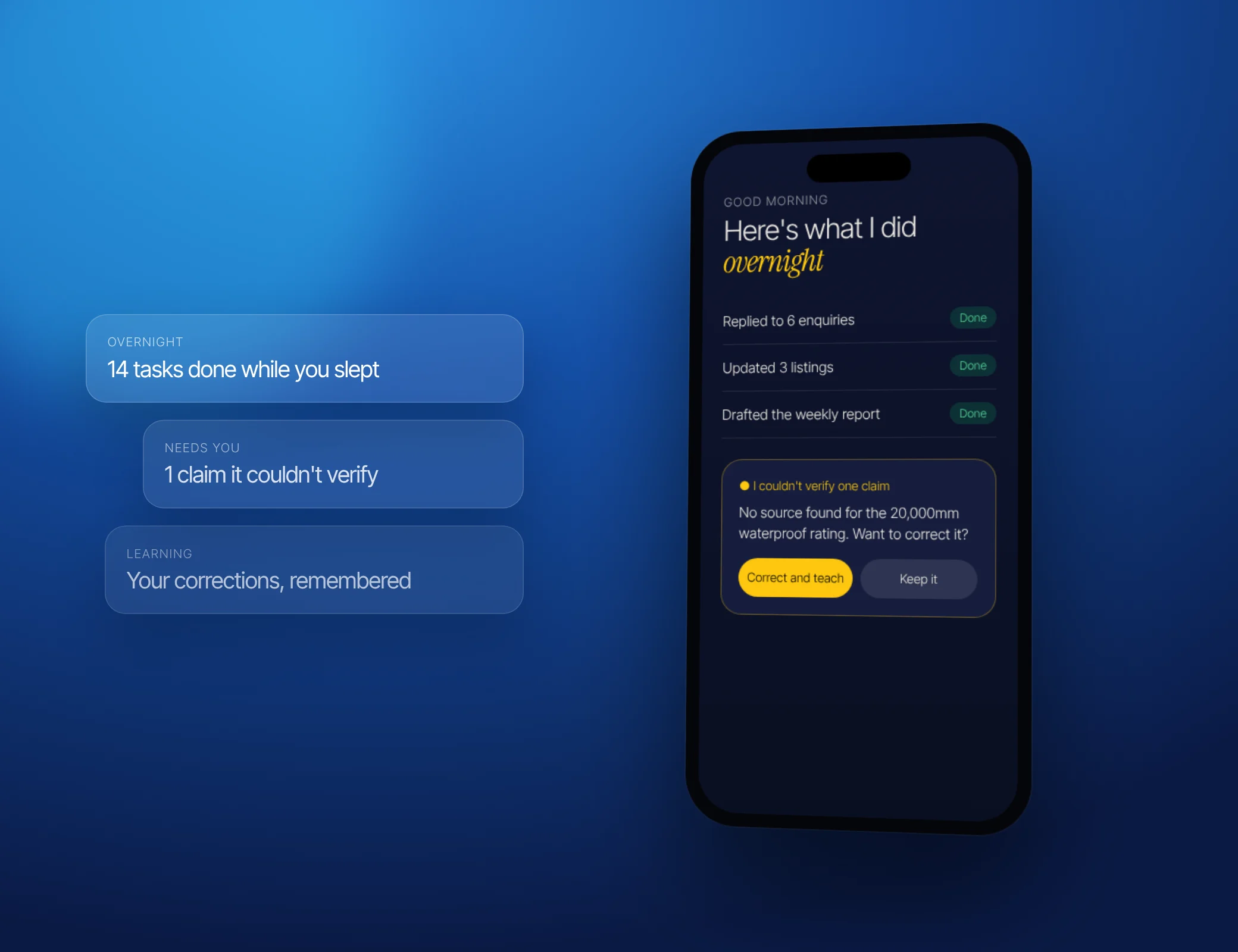
One moment of trust
AI agents are starting to act on our behalf: writing, publishing, buying. The interesting design problem is not the automation. It is the moment a person decides whether to trust what the system did while they were away.
I set myself one constraint: design a single moment, where the person understands why the system acted and can push back in a way that feels like teaching rather than fighting.
Fernwick, 8am
Nightshift is a fictional content agent for Fernwick, a made up outdoor clothing brand. Overnight it wrote and published an article about getting walking boots ready for winter.
At 8am the owner opens her phone. The article reads well, but one product claim could not be verified, and the agent says so plainly instead of hiding it.
Correcting it teaches it
When she corrects the claim, the agent drafts a short rule in plain English, such as only quoting waterproof ratings from the product spec sheet. She can edit the rule, keep it for the future and choose whether to apply it to work already published.
The correction becomes part of how the agent works, so trust builds over time instead of being reset with every mistake.
Five ways to get your boots ready for winter walks
Start with a proper clean. Mud holds moisture against the leather and breaks it down faster than rain ever will.
Our Tarn boot is rated waterproof to 20,000mm, so a good wax is all it needs before the first frost.
I found no source for the 20,000mm rating. Want to correct it?
A working screen, not a static mock
I built it as a working React screen with a phone view and a full width view, so the moment can be felt rather than imagined.
The result is a focused piece of thinking about AI UX that I bring into client work on assistants, automation and anything that acts on a user's behalf.
The most important AI interface is the one that explains itself.
- ✦A single, focused trust moment instead of a whole product
- ✦Plain language disclosure of what the agent could not verify
- ✦Corrections that become reusable rules
- ✦Phone and desktop views in a working prototype